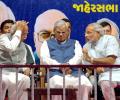
'It is not just about numbers. Sometimes coalitions and alliances have symbolic value.'

At a time when the overall narrative is around India being an attractive investment destination, the two American multinationals are more specific in projecting India as their centrepiece.

'India is showing a reasonable amount of resilience, but we are still living in a world that is quite fragile.' 'That's why we hope that the government will continue to invest significantly in public capex so that we are able to ride through this cycle till the private sector is able to play its part in investing and adding to the capex cycle.'

'We showcased about 20 use cases in 5G trials in Pune and Gandhinagar and some of them were interesting and innovative.' 'However, which ones will take off and which ones would not be relevant, we don't know yet.'

Three business houses are likely to be in the final race to strike a deal with Germany's Metro AG for investing in its India unit -- Metro Cash & Carry. Industry sources in the know named Reliance, Adani Group, and Thailand's conglomerate Charoen Pokphand (CP) as potential frontrunners to acquire a partial or full stake in the Gurugram-headquartered Metro Cash & Carry, which has 31 stores and 5,000 direct employees. Around 20 companies, including strategic and private equity investors, were approached by the German chain, inviting them to bid for the Indian wholesale business, according to a source aware of the M&A developments.

The Tata group has begun its second innings with Air India from a war zone. Being first up in Operation Ganga to evacuate Indian nationals from Ukraine, the salt-to-software conglomerate has faced a real war. But the fire-fighting that the group experienced in appointing a chief executive officer (CEO) for the airline that it acquired from the government in a Rs 18,000-crore deal recently may have felt no less.

Discussing the prospect of more reform earlier this month, telecom minister Ashwini Vaishnaw announced a delay in the 5G spectrum auction. India's telecom sector regulation has to be benchmarked with the global best, he said. It's another matter that many countries have either introduced or are about to roll out 5G services that will enable cutting-edge tech in diverse areas. For India, too, it will mean a lot for healthcare, robotics and unleashing a new chapter in Digital India perhaps.

'Demand is wonderful. We have crossed 10 million on many days.' 'The Swedish trade commissioner recently said, "You guys are vaccinating the entire Sweden in one day".'

The question mark over Vodafone Idea's survival is gone after the government's telecom package, managing director and chief executive officer Ravinder Takkar said in an interaction recently. The extended moratorium for spectrum payments and adjusted gross revenue (AGR) dues has indeed ensured that Vodafone Idea survives, at least for the time being, but questions remain. Answers to those questions may determine the future of Vodafone Idea and its power to stay in a difficult telecom market in the coming years.

The women who made India proud in Tokyo are set to be the Independence Day mascots. Invite from the PM has already gone out to these achievers to be guests of honour on August 15.

'We have the technical expertise, and international collaborations. We also have robust real-time data. We are a university of pandemic management. If the ministry neglects the role of NCDC, it is the loss of the country'

The proposed e-commerce rule book issued recently by the ministry of consumer affairs does not mention foreign companies or foreign direct investment (FDI) at any place, unlike most other government guidelines for the sector so far. That is a heartening development since the latest proposals could be fine-tuned as e-commerce policy.
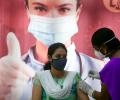
'I'll give it to the vaccine manufacturers without guarantees, take the payment in advance and give me the supplies.' 'The moment you give me one lot of supply, I'll give you more.'


'Some are doing one vaccination with one mobile number and the second with another.' 'Creating more accounts will not multiply the number of slots.'
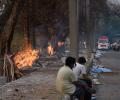
Shortage of ICU beds, oxygen, ventilators, vaccines, doctors, nurses and crematorium space in India has dominated headlines around the world in the past few weeks with Covid-19 cases surging beyond control and the government failing to deliver. Yes, election rallies, Kumbh Mela, blatant flouting of social distancing and mask protocols coupled with a messy vaccination process are said to be responsible for the health crisis of colossal proportions that India is facing today. But an analysis of Budget speeches made by finance ministers over 75 years also offers a glimpse of how low on the priority list healthcare has featured for the political class and policy-makers, which is a significant reason for the current situation.

Becoming a unicorn is surely a marker for a company in its growth story, but it's not a major achievement nor is it a turning point of any significant worth.
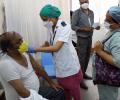
'Ultimately, we have to understand that we don't have the supply at the population scale. 'Therefore, it has to be prioritised.' 'That's what the government has done.'

'Sure, we are teenagers who are doing this part time, but we feel we are making some sort of an impact.'
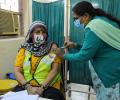
Anybody over 50 years of age or with co-morbidities can get a date, place and time of choice for getting the vaccine shots.
 © 2026 Rediff.com - Advertise with us - Disclaimer - Privacy Policy - Sitemap - Feedback - About us - Terms of use - Grievances